Search This Blog

Thursday, October 21, 2010

2010 Honda Civic Sports Car Type R Mugen 200

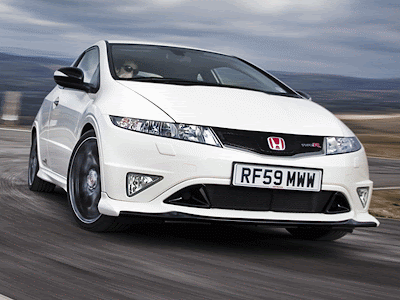
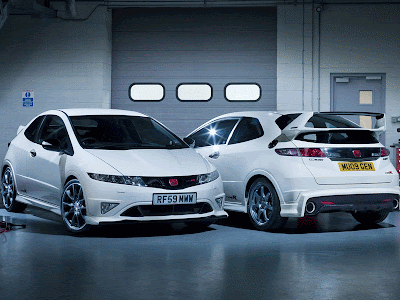
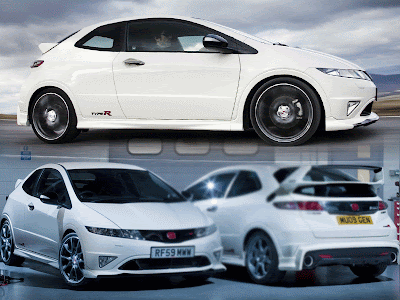
2010 Honda has announced today the launch of their new BTCC team and also premiered the special edition Honda Civic Type R MUGEN 200. As you have probably already guessed, the Honda Civic Type R MUGEN 200 will be built in only 200 units and will go on sale in April. In addition to the jam-packed Civic Type R MUGEN with its tweaked 240HP 2.0-liter i-VTEC, of which only 20 units will be sold in the UK at a hefty £38,599 a piece (approximately US$60,300 or €44,400 at today's exchange rates), Honda today announced that it will offer a less hardcore variant of the hot hatch without the performance upgrades.
2010 Honda Civic Sports Car Type R Mugen 200
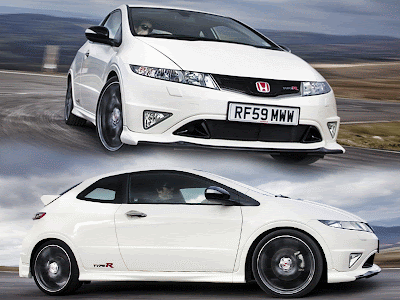
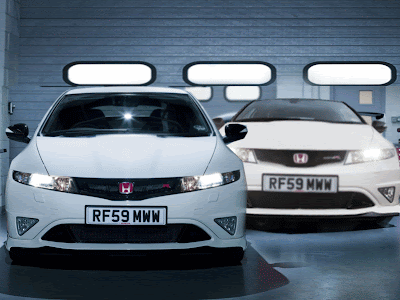
The Honda Civic Type R MUGEN 200 is powered by the standard 201PS i-VTEC engine and features a number of styling upgrades, plus a Limited Slip Differential. The Honda Civic Type R MUGEN 200 features front and rear bumpers with skirts, various badges and a Limited Edition number plaque. The car comes with a Championship White exterior paint and gloss black door mirrors. The Honda Civic Type R MUGEN 200 sits on 19-inch alloy wheels and the company also plans to offer various chassis tuning parts as an option.
2010 Honda Civic Sports Car Type R Mugen 200
The Honda Civic Type R MUGEN 200 price will be announced at a later date and you'll be able to start ordering yours from March. An enhanced, limited edition Civic Type R featuring exclusive MUGEN equipment will go on sale through Honda dealers in the UK in April.
2010 Honda Civic Sports Car Type R Mugen 200
Inspired by MUGEN Euro’s high-performance Type R, the MUGEN 200 is fitted with unique body parts, wheels and badges to give it stand-out looks. As its name suggests, only 200 of the special Type R models will be made. A range of tuning parts, to further enhance the chassis dynamics of the Type R, will also be available as dealer fit options. The order bank for the MUGEN 200 opens in March, when prices will also be announced.
2010 Honda Civic Sports Car Type R Mugen 200
This limited edition Type R continues the association between Honda (UK) and MUGEN Euro – the Northampton-based subsidiary of Honda’s long standing tuning partner MUGEN. Last year, MUGEN used its 36 years of experience and engineering expertise gained at the forefront of global motorsport, to further develop the Type R, and create the Civic Type R MUGEN of which just 20 units will be made.
2010 Honda Civic Sports Car Type R Mugen 200
From April, a network of Honda dealers will also offer an exclusive range of original MUGEN tuning parts for Type R owners to use to modify their own cars – both used and new. These parts will be available to buy from a number of selected dealers across the UK, and will offer a range of tuning and cosmetic parts, including sports suspension upgrades, lightweight wheels and interior trim.
2010 Honda Civic Sports Car Type R Mugen 200
The limited edition car also celebrates the launch of Honda’s BTCC team for 2010, continuing its long-standing relationship with Team Dynamics. The team will compete in two Civics – which will feature a similar White and Black colour scheme to the MUGEN 200 cars. More details will be announced before the first race of the season, which is at Thruxton on 4 April.
2010 Honda Civic Sports Car Type R Mugen 200

2010 Honda Civic Sports Car Type R Mugen 200

2010 Honda has announced today the launch of their new BTCC team and also premiered the special edition Honda Civic Type R MUGEN 200. As you have probably already guessed, the Honda Civic Type R MUGEN 200 will be built in only 200 units and will go on sale in April. In addition to the jam-packed Civic Type R MUGEN with its tweaked 240HP 2.0-liter i-VTEC, of which only 20 units will be sold in the UK at a hefty £38,599 a piece (approximately US$60,300 or €44,400 at today's exchange rates), Honda today announced that it will offer a less hardcore variant of the hot hatch without the performance upgrades.
2010 Honda Civic Sports Car Type R Mugen 200
The Honda Civic Type R MUGEN 200 is powered by the standard 201PS i-VTEC engine and features a number of styling upgrades, plus a Limited Slip Differential. The Honda Civic Type R MUGEN 200 features front and rear bumpers with skirts, various badges and a Limited Edition number plaque. The car comes with a Championship White exterior paint and gloss black door mirrors. The Honda Civic Type R MUGEN 200 sits on 19-inch alloy wheels and the company also plans to offer various chassis tuning parts as an option.
2010 Honda Civic Sports Car Type R Mugen 200
The Honda Civic Type R MUGEN 200 price will be announced at a later date and you'll be able to start ordering yours from March. An enhanced, limited edition Civic Type R featuring exclusive MUGEN equipment will go on sale through Honda dealers in the UK in April.
2010 Honda Civic Sports Car Type R Mugen 200
Inspired by MUGEN Euro’s high-performance Type R, the MUGEN 200 is fitted with unique body parts, wheels and badges to give it stand-out looks. As its name suggests, only 200 of the special Type R models will be made. A range of tuning parts, to further enhance the chassis dynamics of the Type R, will also be available as dealer fit options. The order bank for the MUGEN 200 opens in March, when prices will also be announced.
2010 Honda Civic Sports Car Type R Mugen 200
This limited edition Type R continues the association between Honda (UK) and MUGEN Euro – the Northampton-based subsidiary of Honda’s long standing tuning partner MUGEN. Last year, MUGEN used its 36 years of experience and engineering expertise gained at the forefront of global motorsport, to further develop the Type R, and create the Civic Type R MUGEN of which just 20 units will be made.
2010 Honda Civic Sports Car Type R Mugen 200
From April, a network of Honda dealers will also offer an exclusive range of original MUGEN tuning parts for Type R owners to use to modify their own cars – both used and new. These parts will be available to buy from a number of selected dealers across the UK, and will offer a range of tuning and cosmetic parts, including sports suspension upgrades, lightweight wheels and interior trim.
2010 Honda Civic Sports Car Type R Mugen 200
The limited edition car also celebrates the launch of Honda’s BTCC team for 2010, continuing its long-standing relationship with Team Dynamics. The team will compete in two Civics – which will feature a similar White and Black colour scheme to the MUGEN 200 cars. More details will be announced before the first race of the season, which is at Thruxton on 4 April.
2010 Honda Civic Sports Car Type R Mugen 200

Lamborghini Murcielago LP670 SV 2010 Pictures

Lamborghini Murcielago LP670 SV 2010 Pictures

2010 Cadillac SRX


2010 Cadillac SRX. Cheap Car

Wednesday, October 20, 2010

Legendary Chevrolet Corvette


Legendary Chevrolet Corvette

The legendary Chevrolet Corvette is widely regarded as "America Sports Cara shot upward in 2006 list of the ten hottest, wildest wheels and released by the Road and Travel Magazine. Another horse car, Ford Mustang, came in second. Collecting the elite list of BMW Z4, Hyundai Tiburon, Honda S2000, Mazda MX-5 Miata, Mercedes-Benz SLK, Nissan 350Z Roadster, Dodge Charger, and the new Pontiac Solstice. As expected, almost all the listed cars are sports cars and coupes with the exception of Dodge charger, which is only four seats in the election.

Tuesday, October 19, 2010

2011 Pagani Zonda Tricolore - Pagani Unique Hypercar

Pagani Automobili created the Pagani Zonda Tricolore on the occasion of the celebration of the 50th Anniversary of the "Frecce Tricolori", as a tribute to the National Aerobatic Team.
2011 Pagani Zonda Tricolore
Pagani will introduce the rare cars in the Geneva Motorshow, the 2011 Pagani Zonda Tricolore. Pagani has come up with a new carbon fibre finish for the body of the Zonda Tricolore and there are unique air intakes mounted on top of the rear wings styled to look like the intakes of the jet fighters used by the display team.
2011 Pagani Zonda Tricolore
In 2010 the aerobatic season of the Frecce Tricolori comes to its 50th anniversary, wich will be celebrated on 11th and 12th September at Rivolto Airport.
2011 Pagani Zonda Tricolore
The Frecce Tricolori (Italian, literally Tricolour Arrows), officially known as the 313th Aerobatic Training Squadron is the demonstration team of the Italian Air Force, based at Rivolto Air Force Base, in the north-eastern Italian region of Friuli Venezia-Giulia, province of Udine. They were formed in 1961 as an Air Force team, replacing previous teams that had been sponsored by various commands by the end of the 1920s.
2011 Pagani Zonda Tricolore
The Tricolore comes with a 678bhp version of the Zonda’s 7.3-litre V12, Mercedes-sourced engine and it’s good for 0-62mph in 3.4 seconds and a top speed of 220mph. You’ll need to be as quick as the FrecceTricolore to grab the £1.3 million Pagani Zonda Tricolore though, as Pagani reports several customers have shown an interest in buying the unique hypercar. You should see the Photos Car of the unique design.
2011 Pagani Zonda Tricolore
The team flies the Aermacchi MB-339-A/PAN, a two-seat aircraft capable of 898 km/h at sea level, with nine aircraft and a solo (the highest number of aircraft of any aerobatic team in the world).
2011 Pagani Zonda Tricolore
The Frecce Tricolori belong to the legacy of the entire Italian community. This special edition Zonda is named after the Italian air force aerobatics team, known as the Frecce Tricolori. Italian colored stripes (red, white, green) running up the nose of the car and LED running lights set this Zonda apart from the others. Only 1 will be made at a cost of $2.75 million.
2011 Pagani Zonda Tricolore

2011 Ferrari 599GTO_Best Automotive Class

2011 Ferrari 599GTOSo you still think the hottest street-legal Ferrari of them all is the Enzo? Listen up; we have an update. There’s a new champ in Maranello—it’s not as outrageous as the Enzo, but more powerful, more sophisticated, more agile, and even faster. Ferrari calls it “the most extreme sports car” it has ever produced. At a company where fabulous is the starting point for pretty much every new project, that’s saying something.

Ferrari’s challenge (besides, you know, actually engineering the car) was in choosing a name for the beast, which is based on the 599GTB Fiorano. There isn’t much to set the new car apart visually from the GTB, just additional aero elements at the front, aggressive rear air diffusers, and other various airflow management touches that add up to double the high-speed downforce of the “regular” 599.

The corporate brain trust looked down the corridor of Ferrari immortals, and they came across the 1962–64 GTO, and resurrecting the name just made sense. (Less influence came from the mid-engined, twin-turbo V-8 GTO of 1984, which was based on the 308.) And the 599GTO was born.

GTO Then and Now

Although much has changed since 1962, there are some fundamental similarities between the legendary original and this revival. Both cars are front-engine, rear-drive designs, and both have excellent weight distribution, with essentially all of the powerplant’s mass riding behind the front axle’s centerline. Both sport a small aero upkick on the rear decklid, dubbed a “nolder.” Both cars are propelled by aluminum V-12 engines, and both generate compelling noises as the revs climb toward redline. But of course there’s a little more muscle behind the crescendos coming from the 599GTO’s quadruple tailpipes.

Fed by six two-throat Weber carburetors—remember carburetors?—the 3.0-liter SOHC V-12 that powered the original GTO was rated for 300 hp at 7400 rpm and 250 lb-ft of torque. Feeding power via a five-speed manual gearbox to a limited-slip live rear axle, it was capable of a 5.8-second run to 60 mph, and a top speed of 144 mph.

This was very hot stuff in the early ’60s, and isn’t exactly slow even today. But it’s tame compared to what happens when you set the new car’s manettino (the steering-wheel-mounted dial that controls a number of vehicle functions such as traction and stability control levels and shift response) to Race (the middle position of five), and summon all the horses lurking under the 599GTO’s hood.

There are 671 horses on hand in this version of the 599’s V-12, up from 612 in the 599GTB, and they come quickly when called. As the engine shrieks its way to its 8400-rpm peak, you’re squashed into the racing-style bucket seat, with each upshift through the six-speed gearbox giving an extra little shove.

Split-Second Defined

To understate things, those upshifts don’t take long. With a manettino setting of Race or higher, the single-clutch automated manual takes just 60 milliseconds to go from one gear to the next, according to Ferrari. That’s about twice as fast as the gearbox response in the GTB Fiorano, and beyond the hand speed of any human operating a traditional manual.

2011 Ferrari 599GTOThe oversized shift paddles, which are fixed to the steering column rather than rotating with the wheel, make actuating cog swaps a pure joy, and you find yourself wishing there were a few more gears. At the top end of sixth, flat out, the GTO will be traveling at just over 208 mph, so maybe there are enough gears after all.

Ferrari forecasts a 0-to-62-mph time of 3.35 seconds, quicker than the Enzo. After considering power, mass, phase of the moon, and position of the planets, our tech guys forecast something a little quicker—3.1 seconds—since the GTB Fiorano we tested in September 2008 made the sprint in 3.3.

Power Mining

The GTO’s power increase over the GTB was achieved largely by improved intake and exhaust flow, the latter carefully tuned to emit sounds that are both louder and distinctly more nourishing to the tifosi spirit. The howl of the GTO at full chat: Fantastico!

Other elements of the GTO V-12 include a new 180-degree (flat) crankshaft design with throws designed to twirl more freely, extensive friction-reducing measures that Ferrari says make it 12 percent more efficient than the GTB’s V-12, and improved digital control of the ignition system, which monitors and adjusts every combustion event. Surprisingly, the profiles of the cam lobes are unchanged.

This may sound like a lot of effort for a car whose production—which is beginning as we speak—will be limited to just 599 copies but much of the work had already been done for the more radical 599XX, a car with no stree-legal pretensions whatsoever. In XX trim, the Ferrari engineers have managed to extract 720 hp from the V-12; elements of that transformation compatible with contemporary emissions regulations were used on the GTO project.

The Benign Rocket

Anyway, fast and powerful are traits you’d expect of a car wearing the storied GTO badge. What you might not expect is just how eagerly—and forgivingly—this latest GTO applies that power and speed to a given stretch of straights and curves. The fundamental mechanical elements of the dynamic upgrade versus the standard 599GTB Fiorano and the more aggressive Handling Gran Turismo Evoluzione (HGTE) version are stiffer spring rates and a heftier rear anti-roll bar. There’s also more grip; Ferrari estimates about 1.25 g, thanks to bigger contact patches from 285/30 front and 315/35 rear Michelin rubber made from a new compound; these Pilot Super Sports are a little stickier than the very sticky Pilot Sport Cups.

The combination of more grip, standard (and huge) carbon-ceramic rotors, and Brembo’s new ceramic pads yields superb braking power, with ABS standing by should the driver overpower the tires. During our visit to Italy’s fast 3.1-mile Mugello racetrack, a couple of test drivers managed to jump on the brake pedal hard enough, and at a high enough speed, to reach the ABS threshold. This author was never in danger of having this occur, though I did feel my eyeballs trying to dislodge themselves during a couple of late-braking episodes.

Manettino Magic

As with the 599GTB, a set of auto-adjusting magnetorheological shock absorbers provide wonderfully precise damping, as well as astonishingly comfortable ride quality on public roads. But the element that gives this supercar an exceptional degree of user-friendliness is how well the GTO takes care of its driver at high speeds via the five settings offered by the manettino (it means “little hand”), that small dial mounted on the lower right corner of the steering-wheel center.

As we said, the dial governs traction control, stability control, and shift responses. Its lowest setting is for inclement conditions. Next is Sport, which raises the stability control threshold considerably. In Race, the threshold goes higher still, and shift time is reduced to that magical 60 milliseconds. The next step cancels traction control, and the final position shuts down all the electronic assistance.

This last step is for those who are, yes, brave and accomplished, but also who hold title to the car. I certainly didn’t qualify on the last part, and so confined myself to moving the manettino to the fourth click on my final set of laps. At that level, the system allows a lot more sliding around before it kicks in, but it ultimately steps in and restores some sense of order.

The GTO is a well-balanced package, almost as willing to change direction as the mid-engined F430 or 430 Scuderia. There’s a hint of very mild understeer, easily corrected with the throttle, and if the steering isn’t quite as tactile as that of some sports cars, it’s as accurate as a surgical tool. What all this adds up to is a sporting machine of a very high order, one that recently wrested Ferrari’s production-car lap record at its 1.9-mile Fiorano test track from the Enzo, turning in a time of 1:24.0 versus 1:25.0.

The basic get-in for a 599GTB Fiorano is almost $317,000. Adding the HGTE package costs just over $30,000. But that would still leave you a little over 100 grand in your pockets against the 599GTO, at an estimated $450,000. Does that seem high? The Enzo was some $200,000 north of that, and the 29 copies of the 599XX went for $1.5 million each.

What the 599 prospective GTO owners can look forward to is supercar performance that matches the software wizardry of a car like the Nissan GT-R, but without imposing robotic and passionless precision. The GTO will take care of its driver to the extent the driver finds comfortable, but its soul is omnipresent.

However, if your name isn’t already on the list of future owners, these concerns don’t concern you: All 599 examples are already spoken for. If this seems like favoritism, consider that no single Ferrari begins its gestation without an owner’s name on the build sheet, and that the company began inviting carefully selected GTO prospects to visit its headquarters in early January. So, yeah, it’s pretty much favoritism.

2011 Ferrari 599GTO2011 Ferrari 599GTO2011 Ferrari 599GTO2011 Ferrari 599GTO2011 Ferrari 599GTO2011 Ferrari 599GTO
2011 Ferrari 599GTO2011 Ferrari 599GTO2011 Ferrari 599GTO2011 Ferrari 599GTO2011 Ferrari 599GTO2011 Ferrari 599GTO2011 Ferrari 599GTO
2011 Ferrari 599GTO2011 Ferrari 599GTO2011 Ferrari 599GTO
2011 Ferrari 599GTO
2011 Ferrari 599GTO


2011 Ferrari 599GTO